Whatspp/Phone:
+8618666402929
Email:info@shinysteeljewelry.com
Factory address:
No. 5 Changsheng Road, Chang’an Town, Dongguan City, Guangdong Province, China.
 Skip to content
Whatspp/Phone:
+8618666402929
Email:info@shinysteeljewelry.com
Factory address:
No. 5 Changsheng Road, Chang’an Town, Dongguan City, Guangdong Province, China.

To the naked eye, polished titanium and stainless steel jewelry look almost exactly the same.
But under the surface? They perform completely differently.
Whether you are a consumer trying to avoid skin irritation, or a brand owner trying to figure out which is better for jewelry titanium or stainless steel to minimize your return rates…
You are in the right place.
As a manufacturer who works with both of these metals every single day, I know that choosing the right material isn’t just about the shine—it’s about weight, durability, and biocompatibility.
In this guide, you are going to learn the exact, no-nonsense differences between the two metals, straight from the factory floor.
Let’s dive right in.
When we discuss premium metal jewelry manufacturing, the conversation often narrows down to two heavyweights: Stainless Steel and Titanium. As an OEM/ODM manufacturer, we work extensively with both materials daily. Understanding their technical DNA is the first step in deciding which is better for your brand’s collection.
316L Stainless Steel is the industry standard for high-quality fashion jewelry. It is an alloy, meaning it is a mixture of metals designed for specific performance characteristics. The “L” stands for “Low Carbon,” which is crucial for corrosion resistance.
At our factory, we exclusively use 316L Surgical Stainless Steel (and occasionally 304 for specific components) because it offers the perfect balance of durability and workability.
Titanium is a natural chemical element (Ti), not an alloy mixture like steel. It is renowned for its incredible strength-to-weight ratio. In the jewelry world, specifically for body piercing and high-end rings, we use specific grades that prioritize biocompatibility.
You might see the term “Titanium Steel” floating around marketing materials or online marketplaces. Let’s be clear: There is no such thing as “Titanium Steel” in metallurgy.
This is a marketing buzzword, usually invented to make standard stainless steel sound more exotic or durable.
| Term | Reality |
|---|---|
| Stainless Steel | An iron-carbon alloy with chromium. Heavy, shiny, durable. |
| Titanium | A pure element. Greyish, matte, ultra-lightweight. |
| “Titanium Steel” | Marketing Myth. Usually just 316L Stainless Steel re-branded to sound expensive. |
As a transparent manufacturer, we label our materials strictly by their true grade: 316L Stainless Steel or Genuine Titanium. Knowing the difference ensures you get exactly what you pay for.
When clients ask me which is better for jewelry titanium or stainless steel, I always break it down by lifestyle and preference. Both are incredible materials for modern jewelry production, but they cater to very different needs. Let’s look at how they stack up in everyday wear to determine which one is better stainless steel or titanium for your specific style.
The titanium vs steel weight difference is the first thing you notice when holding both.
Both metals are incredibly tough, but they perform differently on the Mohs hardness scale jewelry manufacturers use.
As a supplier focused on high-quality hypoallergenic jewelry metals, I pay close attention to material safety.
The visual vibe is where these two metals truly diverge.
| Feature | Stainless Steel Jewelry | Titanium Jewelry |
|---|---|---|
| Weight | Heavy, solid luxury feel | Featherlight, unnoticeable |
| Hardness (Mohs) | ~5.5 to 6 | ~6.0 |
| Skin Safety | Hypoallergenic (316L grade) | 100% Biocompatible |
| Look & Finish | Bright, highly reflective mirror shine | Darker, gunmetal grey aesthetic |
| Maintenance | Easy to polish and restore | Difficult to re-polish once scratched |
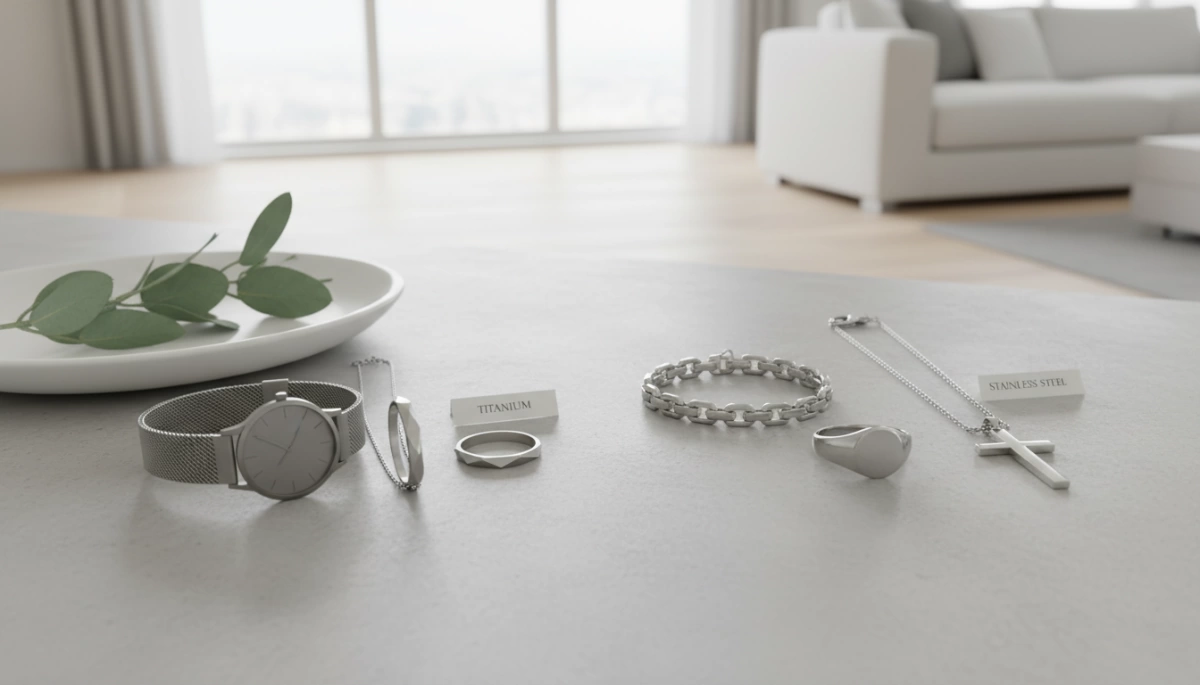
Deciding which is better for jewelry, titanium or stainless steel, isn’t just about the raw material—it’s about the application. As a manufacturer handling thousands of OEM projects, we see distinct advantages for each metal depending on whether you are producing heavy rings, delicate chains, or safety-focused body jewelry.
For most fashion brands and retailers, Stainless Steel (316L) is the reigning champion for rings. The primary reason is the “hand feel.” Stainless steel has a substantial weight that mimics precious metals like platinum or white gold, giving the customer a sense of luxury and value. Additionally, stainless steel is the ideal substrate for PVD plating, allowing for vibrant Gold, Rose Gold, and Black finishes that are highly durable.
While titanium is incredibly strong, its featherweight can sometimes feel “cheap” to consumers expecting a heavier piece of jewelry. However, for simple, grey-tone men’s wedding bands where weight reduction is a priority, titanium has a niche. But for intricate designs involving CNC precision and complex plating, stainless steel is the superior manufacturing choice.
This category is where the battle shifts. When dealing with fresh piercings or body modification, safety is the only metric that matters.
When it comes to neckwear, the manufacturing complexity of links plays a huge role. Stainless Steel is vastly preferred for chains and necklaces for two reasons: drape and workability.
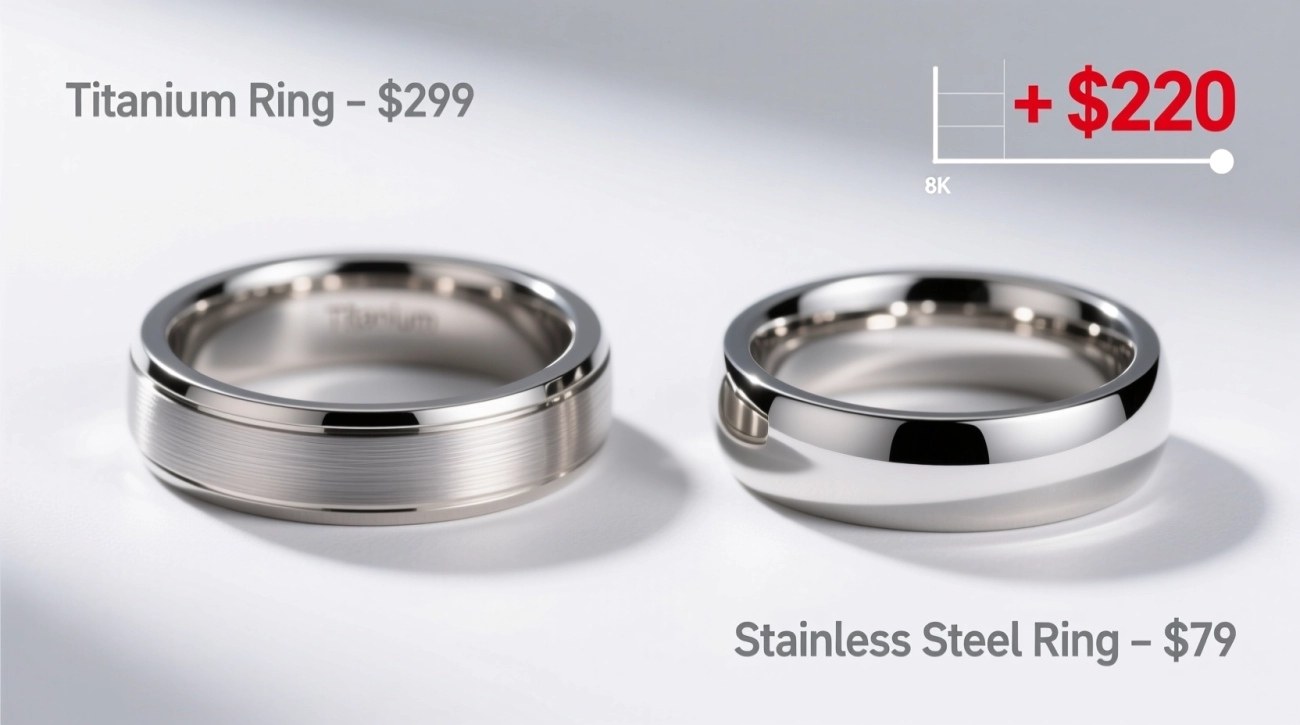
When we are asked which is better for jewelry titanium or stainless steel, the conversation always comes down to price and production value. Both metals are incredibly durable, but they sit at very different price points for specific manufacturing reasons.
Stainless steel jewelry is the undisputed champion of budget-friendly manufacturing. It delivers a heavy, premium feel without the luxury price tag.
Titanium is a premium metal, and its higher price reflects the difficulty of manufacturing it. It is not just the raw material that costs more; it is the labor and equipment.
For anyone managing OEM jewelry production or scaling a brand in the United States, balancing your catalog between these two metals is the key to healthy profit margins.
| Metal | Production Cost | Retail Price Point | Profit Margin Strategy |
|---|---|---|---|
| Stainless Steel | Low | Accessible | Driven by high-volume sales. Ideal for everyday fashion pieces and custom engraved stainless steel rings where you can maximize markups. |
| Titanium | High | Premium | Driven by niche, high-ticket sales. Customers are willing to pay a premium for its featherlight feel and extreme durability. |
Ultimately, stainless steel gives us the flexibility to dominate the mass market with strong profit margins, while titanium serves as a premium upsell for buyers looking for specialized, technical metals.
When you are trying to figure out which is better for jewelry titanium or stainless steel, daily upkeep is a massive factor. Fortunately, both of these metals are much lower-maintenance than traditional silver or gold. I always tell my customers that you don’t need a professional cleaning kit to keep these pieces looking their best.
Whether you are wearing everyday stainless steel jewelry or a heavy-duty titanium band, the basic cleaning routine is exactly the same. You can skip the harsh chemicals completely.
For a deeper dive into jewelry tarnish removal and extending the life of your everyday pieces, I highly recommend reading through our complete guide on how to clean stainless steel jewelry.
Even the toughest jewelry manufacturing materials will eventually show some wear and tear. Here is how the two metals stack up when it comes to fixing scuffs:
Here is the breakdown of the most frequent questions we get from brands and wholesalers deciding which is better for jewelry titanium or stainless steel for their next collection.
Generally, no. We exclusively use 316L Surgical Stainless Steel and 304 Stainless Steel, both engineered to resist corrosion and oxidation. While cheaper metals might turn green, high-grade 316L handles water exposure very well. For colored pieces, our benefits of choosing stainless steel jewelry include advanced PVD plating, which creates a durable bond that protects the finish far better than traditional plating methods, making it safe for daily wear.
The short answer is usually no. Because titanium is incredibly hard and durable, it does not bend or solder like gold or silver. Once a ring is machined via CNC precision, the size is fixed. This is why we recommend brands take advantage of our flexible MOQs to order a range of precise sizes rather than relying on resizing later.
Both materials are excellent choices for sensitive skin, but they serve different needs.
If you are stocking a line of men’s pierced earrings or body jewelry, titanium is often the premium choice for safety, while stainless steel offers the best balance of safety and style for everyday fashion.
If you don’t have a label, check these two factors: