Whatspp/Phone:
+8618666402929
Email:info@shinysteeljewelry.com
Factory address:
No. 5 Changsheng Road, Chang’an Town, Dongguan City, Guangdong Province, China.
 Skip to content
Whatspp/Phone:
+8618666402929
Email:info@shinysteeljewelry.com
Factory address:
No. 5 Changsheng Road, Chang’an Town, Dongguan City, Guangdong Province, China.

Ever bought a piece of jewelry labeled “safe for sensitive skin” only to end up with an itchy, red rash hours later? As someone deeply involved in the jewelry industry, I hear this frustration from our customers all the time. Before we can definitively answer whether stainless steel jewelry is hypoallergenic, we have to set the record straight on what that word actually means.
Here is the honest truth: “hypoallergenic” does not mean 100% allergy-proof. By definition, the prefix “hypo-” simply translates to below normal or slightly. When a piece is marketed as hypoallergenic, it means the materials used are significantly less likely to cause a reaction than those in standard fashion jewelry. It is a high-level safeguard, not an absolute medical guarantee.
When your skin reacts poorly to a new necklace or pair of earrings, the issue usually boils down to a single ingredient.
Understanding this distinction is the first step to finding pieces you can comfortably wear all day, every day.
If you have a nickel allergy, hearing that stainless steel contains 8% to 14% nickel might sound like a red flag. You are probably wondering: is stainless steel a hypoallergenic metal at all? Yes, it absolutely is. The answer lies in how the metal is built, not just what goes into the melt.
The secret to stainless steel isn’t the absence of nickel; it is the addition of chromium. When exposed to the air, chromium creates an invisible, microscopic shield. This is the chromium oxide layer in stainless steel.
Here is exactly what this self-healing barrier does for your skin:
The Key Takeaway: A jewelry allergy is not triggered by a metal containing nickel, but by a metal that releases nickel. Because the nickel is completely trapped and isolated from your body, stainless steel remains incredibly safe for sensitive skin. This secure structural bond is exactly why we rely on it for prolonged skin contact, especially for highly sensitive placements like our lip stud piercing designs.

When asking if stainless steel a hypoallergenic metal, the answer heavily depends on the exact grade of the alloy. In the jewelry industry, you will typically run into two main types of steel, and they perform very differently on sensitive skin.
For anyone prone to contact dermatitis from jewelry, 316L surgical stainless steel is the absolute safest bet. If you want to understand exactly why this specific alloy outperforms the rest on a structural level, check out our expert guide to 316L durability. We strictly rely on 316L because it is the only way to guarantee true peace of mind for sensitive skin.
Adding a shiny gold finish changes how a piece of jewelry interacts with your skin. So, is gold plated stainless steel jewelry hypoallergenic? The honest answer is that it entirely depends on the plating method. The top layer is what actually rests against your body, and how it’s applied makes all the difference for sensitive skin.
Many budget accessories rely on standard electroplating or “flash-plating.” If you have sensitive skin, this is a major red flag.
To keep jewelry safe and durable, the industry standard for high-quality pieces is Physical Vapor Deposition (PVD) plating. This high-tech vacuum-coating process bonds the gold to the steel at the molecular level.
As a dedicated PVD gold-plated jewelry manufacturer, we strictly utilize this vacuum coating technology. We ensure that our gold finishes lock in color beautifully while maintaining the exact same hypoallergenic safety as the premium surgical steel underneath.
Let’s shoot straight: can you be allergic to stainless steel jewelry? Yes, but it is incredibly rare. While 316L surgical stainless steel is the industry standard and clearly proves why is stainless steel jewelry good for sensitive skin, extreme outliers do exist.
If you have a medically diagnosed, severe hypersensitivity to nickel, there is still a slight chance of experiencing contact dermatitis jewelry reactions. Even though the nickel is tightly locked within the metal’s structure, hyper-reactive skin might still throw a red flag.
If you have known, severe metal allergies nickel reactions, we always recommend playing it safe with a simple test run before committing:
When figuring out is stainless steel jewelry hypoallergenic, it helps to see exactly how it stacks up against other common metals on the market. We constantly see buyers comparing these options for their everyday wear. Here is the straightforward breakdown:
Ultimately, when asking is stainless steel a hypoallergenic metal compared to the rest, it consistently wins out as the most practical, budget-friendly, and skin-safe option for daily wear in the US market.
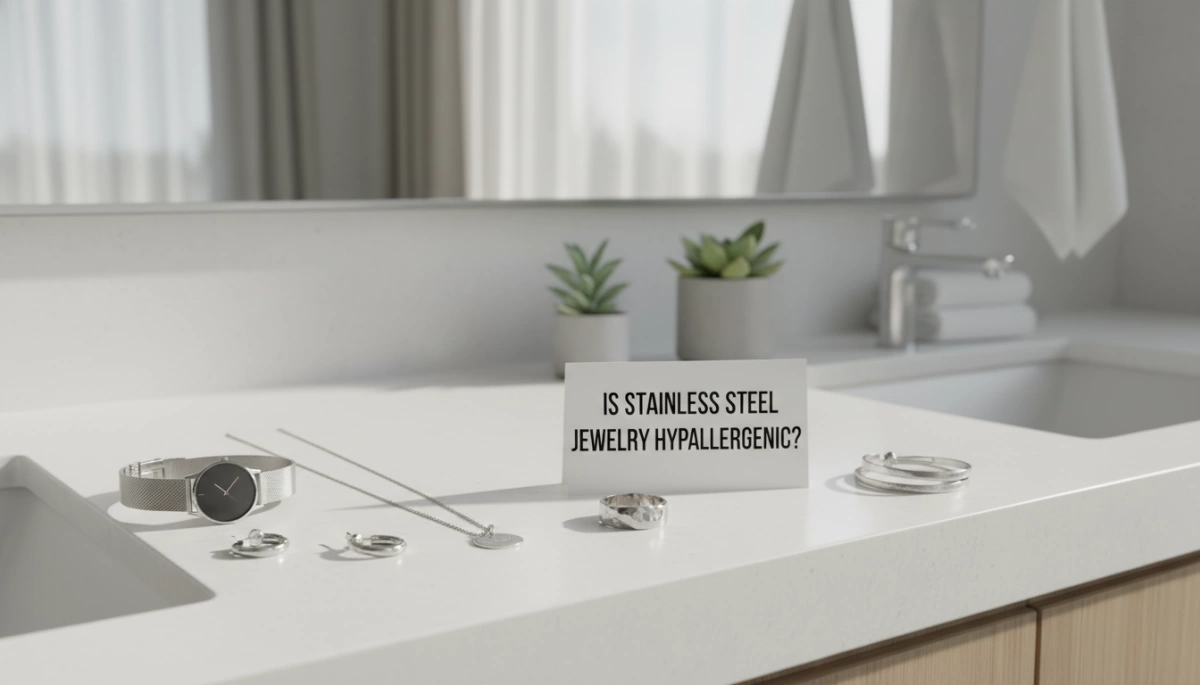
Earlobes are notoriously sensitive, especially when it comes to fresh or irritated piercings. If you are wondering, are stainless steel earrings hypoallergenic?, the short answer is yes—provided you wear the right grade. Earrings made with 316L surgical stainless steel posts are exceptionally safe for sensitive ears. The strong chromium oxide layer locks any trace of nickel deep within the metal, preventing contact dermatitis and keeping your earlobes comfortable all day.
We frequently get asked: are stainless steel rings hypoallergenic? Absolutely. However, because rings sit tightly against your finger, they can easily trap sweat, hand sanitizer, and water. While this trapped moisture can occasionally cause a mild, friction-based rash, the 316L steel itself will not cause an allergic reaction. If you are looking for a durable, everyday band that won’t turn your skin green, our stainless steel rings are designed to handle constant wear and moisture while keeping your skin perfectly safe.
To quickly recap: is stainless steel jewelry good for sensitive skin overall? Yes, it is one of the smartest choices you can make. It stands out as a top-tier hypoallergenic metal for a few simple reasons:
For anyone struggling with metal allergies, 316L stainless steel is a reliable, irritation-free solution.
When asking yourself, is stainless steel jewelry good for sensitive skin, the manufacturer you choose matters. At ShinySteelJewelry, we pride ourselves on being an industry expert and a trusted partner for customers across the United States. We know exactly what goes into our pieces, ensuring you get the safest, highest-quality products available. Whether you are shopping for your own collection or exploring the benefits of choosing stainless steel jewelry for your business, we have you covered.
Here is exactly how we guarantee our jewelry is safe for you:
We build reliable, tarnish-free jewelry you can wear every single day without the worry.
 Optimized by Seraphinite Accelerator