Whatspp/Phone:
+8618666402929
Email:info@shinysteeljewelry.com
Factory address:
No. 5 Changsheng Road, Chang’an Town, Dongguan City, Guangdong Province, China.
 Skip to content
Whatspp/Phone:
+8618666402929
Email:info@shinysteeljewelry.com
Factory address:
No. 5 Changsheng Road, Chang’an Town, Dongguan City, Guangdong Province, China.

You might already know the heartbreak of buying a stunning piece of “gold” jewelry, only to watch it fade or turn your skin green just a few weeks later.
It’s the ultimate jewelry frustration.
But what if I told you the secret to truly tarnish-resistant jewelry comes down to a literal space-age technology?
In this post, you’re going to learn exactly what separates the accessories that survive your toughest gym sessions from the pieces that require constant babying. We are breaking down the ultimate industry showdown: PVD plating vs traditional plating jewelry.
You’ll discover the core differences between modern Physical Vapor Deposition and the classic electroplating process, and how these methods directly impact your everyday wear.
If you want to know why ShinySteelJewelry exclusively chooses PVD for modern, high-performance accessories—and how to finally build a waterproof collection that actually lasts—this guide is for you.
Let’s dive right in.
When I select pieces for my collection, I prioritize how the finish is applied because it dictates exactly how long your jewelry will stay beautiful. While both methods aim to give jewelry a premium gold or silver look, the science behind them is worlds apart.
The electroplating process is the industry standard for most fashion jewelry. It involves submerging a base metal—usually brass or copper—into a chemical bath containing dissolved metal ions, such as gold or rhodium.
Physical Vapor Deposition (PVD) is a modern, high-tech alternative that I rely on for high-performance jewelry. Instead of a liquid bath, this happens inside a specialized vacuum coating technology chamber.
The biggest difference I emphasize to my clients is how the metal attaches to the piece.
By choosing PVD, you aren’t just getting a color coating; you are getting a surface that has been fundamentally transformed. This atomic bond is why PVD jewelry is significantly more durable and resistant to the daily wear and tear that usually destroys traditional plated pieces.
When I look at the jewelry market today, the biggest differentiator between a piece that lasts and one that ends up in the trash is the coating technology. In the battle of PVD plating vs traditional plating jewelry, durability is where the real winner is decided.
Traditional electroplating usually results in a soft layer of gold that scratches if you so much as look at it wrong. PVD (Physical Vapor Deposition) is a different beast entirely. On the jewelry durability scale, PVD coatings are significantly harder than traditional gold plating.
Most traditional plated jewelry reacts poorly to the salt in your sweat or the chlorine in a pool. This leads to that dreaded green skin or the plating flaking off. Because 18k gold PVD coating is applied in a vacuum, it creates a dense, non-porous layer that is incredibly tarnish-resistant jewelry.
Whether you are wearing a stainless steel gold chain during a high-intensity workout or forgetting to take off your rings in the shower, PVD holds up. It is effectively sweat-proof jewelry because the bond is molecular, meaning it won’t react to moisture or body oils the way standard electroplating does.
I always tell my customers that you get what you pay for when it comes to longevity.
The fusion created during the PVD process ensures the color doesn’t just sit on top; it becomes part of the surface. This makes it the superior choice for anyone looking for long-term value over fast-fashion disposability.
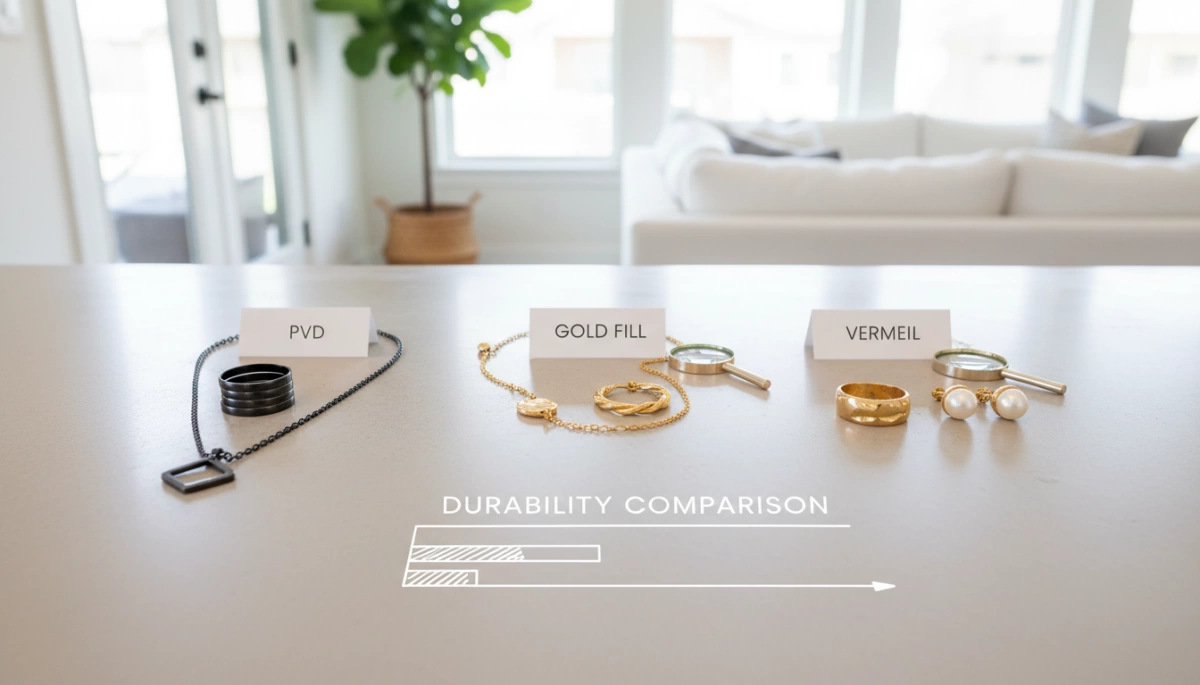
When comparing PVD plating vs traditional plating jewelry, it is essential to look at how this technology stacks up against other industry standards like gold filled, vermeil, and rhodium. I see many customers torn between the “luxury” label of traditional methods and the “indestructible” reputation of PVD. Here is how they actually compare in the real world.
Gold filled jewelry involves mechanically bonding a thick layer of gold to a base metal using heat and pressure. While gold filled has a higher gold content by weight, Physical Vapor Deposition offers a superior atomic bond. PVD doesn’t just sit on top of the metal; it becomes part of the surface. This makes PVD-coated stainless steel significantly more resistant to peeling or flaking compared to gold filled items, especially in high-friction pieces like rings or a stainless necklace for men.
Gold vermeil is often marketed as a high-end alternative because it uses sterling silver as a base. However, luxury doesn’t always mean durable. Vermeil relies on standard electroplating, which is thin and prone to tarnishing as the silver underneath reacts with the air. PVD plating on a stainless steel base is the practical winner here. It provides the same 18k gold look but is completely tarnish-resistant and won’t turn your skin green after a week of wear.
Rhodium is prized for its brilliant, reflective white finish, commonly used to coat white gold. The downside is its lifespan; rhodium is a thin “flash” plating that wears off quickly, requiring expensive re-plating every 6 to 12 months. PVD offers a much higher Vickers hardness, meaning the finish stays bright and intact for years without maintenance. For those looking for daily-wear staples, our custom stainless steel earrings utilize PVD technology to ensure the finish never fades or requires a trip back to the jeweler.
| Feature | PVD Plating | Gold Filled | Gold Vermeil | Rhodium Plating |
|---|---|---|---|---|
| Bonding Strength | Atomic Fusion | Mechanical | Chemical Ion | Chemical Ion |
| Daily Durability | Extreme | High | Moderate | Low |
| Tarnish Resistance | Excellent | Good | Poor | Moderate |
| Waterproof? | Yes | Mostly | No | No |
| Maintenance | Zero | Low | High | High (Re-plating) |
Key Takeaways:
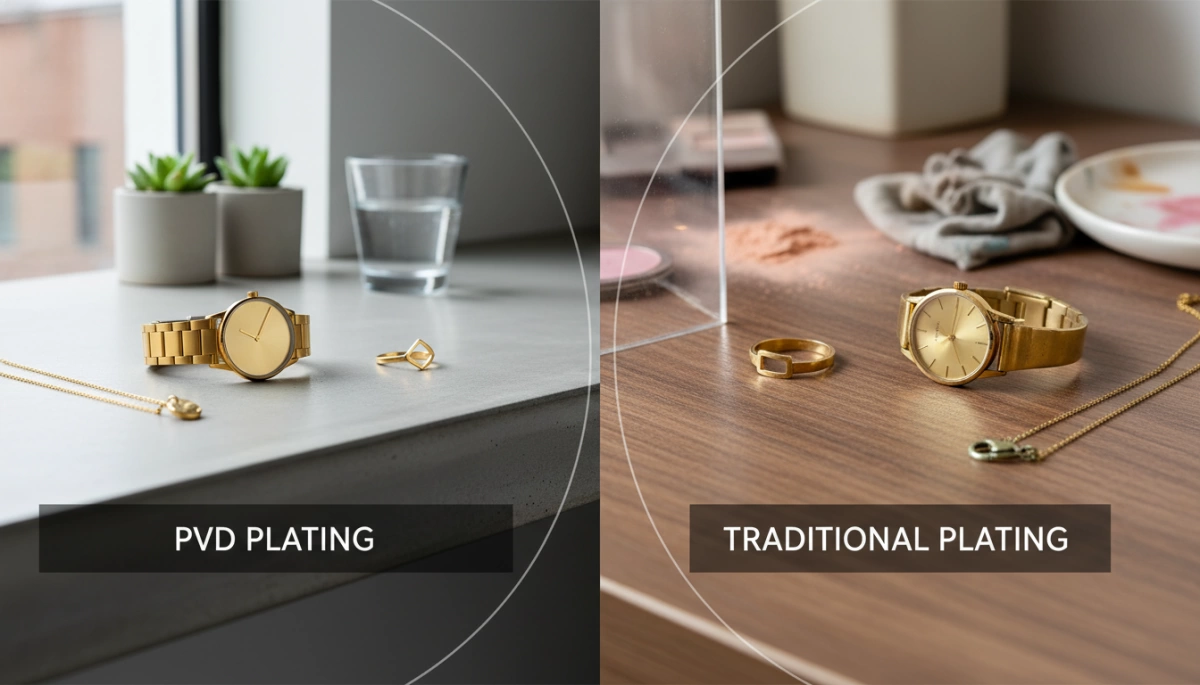
When I choose pieces for my collection, I think about how they fit into a real, busy life. The main difference between PVD plating vs traditional plating jewelry often comes down to how much you have to “baby” the piece. If you live an active lifestyle, the choice becomes very clear.
Traditional electroplating often relies on a nickel base layer to help the gold stick. For many of my customers, this is a dealbreaker that leads to green skin or rashes. Physical Vapor Deposition is a much safer bet. Because it is a nickel-free plating process and often applied over medical-grade metals, it provides superior hypoallergenic jewelry finishes that won’t irritate your skin even during heavy sweat or long-term wear.
There is a lot of noise about “waterproof” jewelry, but not all plating handles moisture the same way. Traditional plating has microscopic pores that allow water and salt to reach the base metal, causing it to flake. PVD is different. It creates a dense, non-porous layer that is genuinely sweat-proof jewelry. Whether you are hitting the gym or heading to the beach, understanding what makes jewelry waterproof is essential for protecting your investment.
I prefer jewelry that doesn’t require a 10-step cleaning routine. PVD pieces are designed for “set it and forget it” wear, while traditional pieces require constant attention to avoid tarnish.
| Feature | PVD Plating Jewelry | Traditional Electroplating |
|---|---|---|
| Gym & Shower Safe | Yes, highly resistant | No, will wear off quickly |
| Skin Reaction | Hypoallergenic / Nickel-free | Risk of irritation/green skin |
| Cleaning Needs | Simple wipe with a soft cloth | Specialized cleaners & polishing |
| Daily Durability | High; resists scratches | Low; prone to chipping |
| Storage | Anywhere | Must be kept in airtight bags |
Choosing PVD means you don’t have to take your rings off every time you wash your hands or worry about ruining a necklace during a summer workout. It is the ultimate solution for anyone who wants the look of luxury without the fragile maintenance requirements.
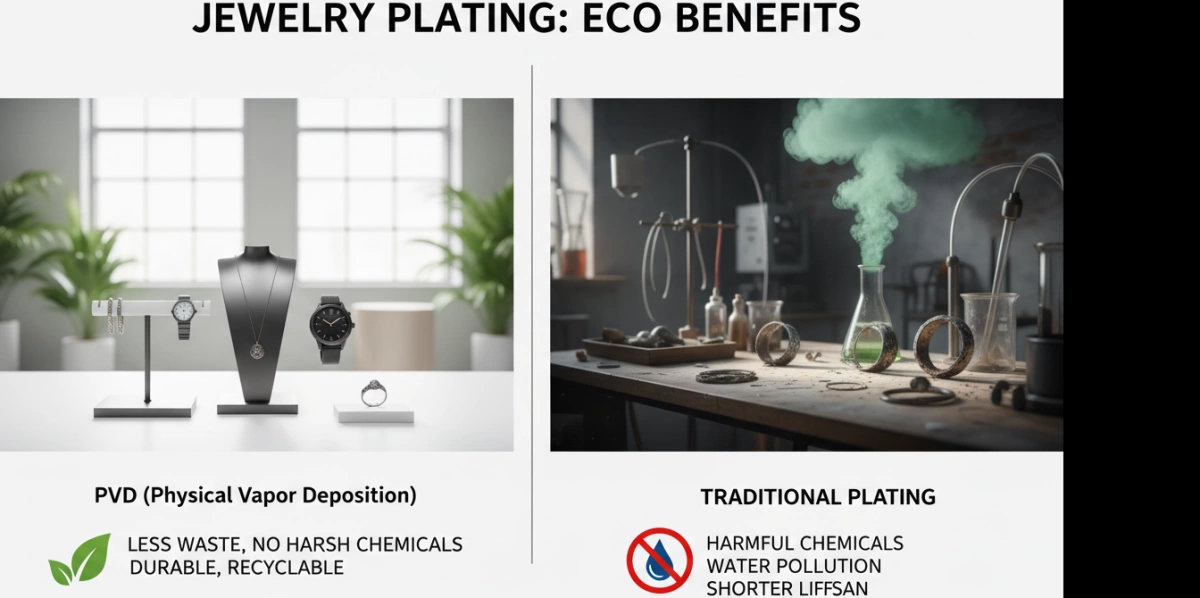
I prioritize sustainability in my production process, and this is where the gap between PVD plating vs traditional plating jewelry becomes most apparent. Traditional electroplating relies on heavy chemical baths, often involving cyanide, chromium, and other hazardous acids. These processes generate significant toxic runoff and liquid waste that require intensive chemical treatment before disposal to avoid contaminating local water supplies.
In contrast, Physical Vapor Deposition (PVD) is a clean, dry process. Because the entire operation occurs within a sealed vacuum chamber using plasma, there are no toxic chemicals to leak and no harmful gases released into the atmosphere. As a high-quality stainless steel jewelry manufacturer, I utilize PVD because it represents the gold standard for “green” technology in the modern jewelry market.
Why PVD is the sustainable choice:
Choosing PVD-coated pieces allows you to enjoy luxury finishes without the environmental guilt associated with old-school chemical dipping methods. It is the most responsible way to produce high-performance, long-lasting jewelry for the eco-conscious consumer.
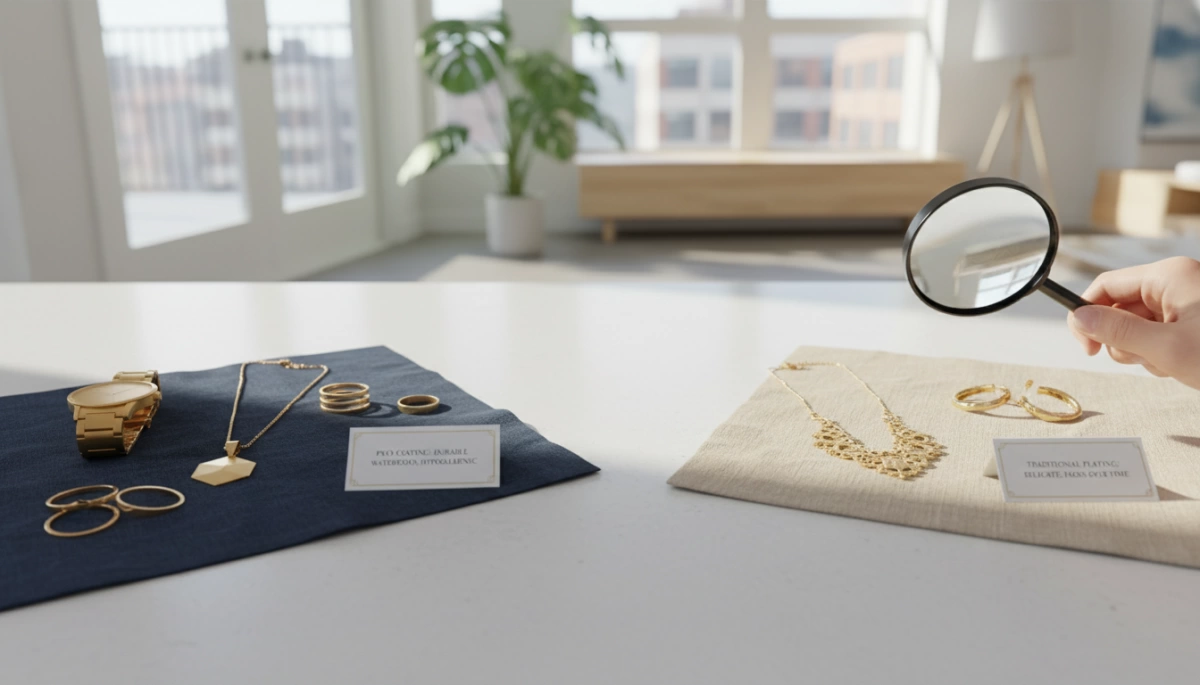
When weighing PVD plating vs traditional plating jewelry, the decision ultimately comes down to your lifestyle and how you plan to wear your pieces. I always advise looking at your daily routine before making a purchase to ensure you get the best value for your money.
Traditional electroplating works perfectly for statement pieces or trendy items you only wear once in a while.
If you want jewelry you can put on and forget about, PVD is the clear winner. Vacuum coating technology provides incredible wear resistance that stands up to the rigors of daily life.
Is the price worth it? Let’s break down the real cost of ownership. While creating custom cast steel jewelry with a PVD finish costs slightly more upfront, it easily pays for itself by eliminating the need for constant replacements.
| Feature | Traditional Plating | PVD Plating |
|---|---|---|
| Initial Cost | Lower | Slightly Higher |
| Lifespan | Months | Years to Decades |
| Maintenance | High (Needs careful storage) | Low (Wear it anywhere) |
| True Value | Poor for daily use | Excellent long-term investment |
You save money in the long run by investing in high-quality PVD plating jewelry that actually lasts, rather than throwing away cash to replace cheap traditional pieces every few months.
I get a lot of questions from customers trying to decide between PVD plating vs traditional plating jewelry. Here are the straight answers to the most common questions we hear regarding these two finishes.
While nothing lasts forever, Physical Vapor Deposition offers incredible wear resistance. Unlike standard finishes that chip away in months, PVD bonds at the atomic level. With basic care, your PVD plating jewelry can last for years without showing significant wear or fading.
Yes. Because PVD creates highly tarnish-resistant jewelry, it can easily handle water, soap, and your daily routine. It is essentially sweat-proof jewelry, making it perfect for active lifestyles. For instance, if you are someone who never takes off your custom stainless steel bracelets, a PVD finish ensures they will survive daily showers and heavy gym sessions without losing their shine.
Yes, the material used inside the vacuum coating technology is real gold. An 18k gold PVD coating uses actual 18-karat gold that is vaporized and fused directly to a durable core, typically a stainless steel base metal. You get the exact look and color of solid gold but with unmatched durability.
When comparing pvd plating vs electroplating, the traditional electroplating process simply dips the jewelry into a chemical bath, leaving a fragile, microscopic layer of metal resting on the surface. This thin layer easily rubs off from daily friction, natural body oils, and lotions. Once that top layer breaches, the cheap base metal underneath is exposed to the air, leading to rapid oxidation and tarnishing.


