Whatspp/Phone:
+8618666402929
Email:info@shinysteeljewelry.com
Factory address:
No. 5 Changsheng Road, Chang’an Town, Dongguan City, Guangdong Province, China.
 Skip to content
Whatspp/Phone:
+8618666402929
Email:info@shinysteeljewelry.com
Factory address:
No. 5 Changsheng Road, Chang’an Town, Dongguan City, Guangdong Province, China.

We’ve all been there: you buy a beautiful “gold-plated” necklace, wear it to the beach once, and by sunset, your skin is green and the finish is ruined.
It’s frustrating, wasteful, and for a long time, it was just the “price” you paid for affordable accessories. But the industry is shifting.
If you’ve seen brands claiming their pieces are 100% waterproof, you might be skeptical. Is it just marketing fluff, or has the science actually caught up? The truth lies in a massive manufacturing breakthrough: the combination of 316L Surgical Stainless Steel and PVD Plating (Physical Vapor Deposition).
In this guide, I’m pulling back the curtain on the molecular bonding process that makes jewelry tarnish-resistant, sweat-proof, and ocean-ready. Whether you’re a shopper tired of “disposable” gold or a brand owner looking for affordable luxury durability, you’re going to learn exactly why this technology changed everything.
Let’s dive in.
We’ve all seen it: a favorite “gold” necklace turns a muddy brown after a few wears, or worse, leaves a stubborn green ring around your neck. As an industry insider, I can tell you that most non-tarnish jewelry claims are simply marketing fluff. To understand why waterproof jewelry that won’t tarnish is such a breakthrough, we first have to look at why traditional pieces fail so miserably in the real world.
At its core, tarnishing is a chemical reaction. When common jewelry metals are exposed to oxygen and moisture—whether from the air, your sweat, or a quick dip in the pool—they undergo oxidation.
Most affordable jewelry is made via gold electroplating, often referred to as “dipped” jewelry. In my manufacturing experience, this is the primary reason why “waterproof” claims often fall short.
| Feature | Traditional Electroplating | The Problem |
|---|---|---|
| Process | A thin layer of gold is chemically deposited in a liquid bath. | The bond is purely superficial and lacks density. |
| Thickness | Usually 0.5 to 2.0 microns. | It’s microscopic; even light friction from clothing rubs it off. |
| Durability | Low resistance to chemicals and salt. | Perfumes, lotions, and soap dissolve the gold layer over time. |
The dreaded “green skin” effect isn’t an allergy; it’s a chemical reaction between your skin’s acidity and the reactive base metals used in cheap manufacturing.
If you’ve been searching for no tarnish waterproof jewelry, you’ve likely realized that standard “dipped” gold isn’t the answer. The industry needed a structural shift in how gold is bonded to metal—and that’s where high-tech vacuum deposition comes in.
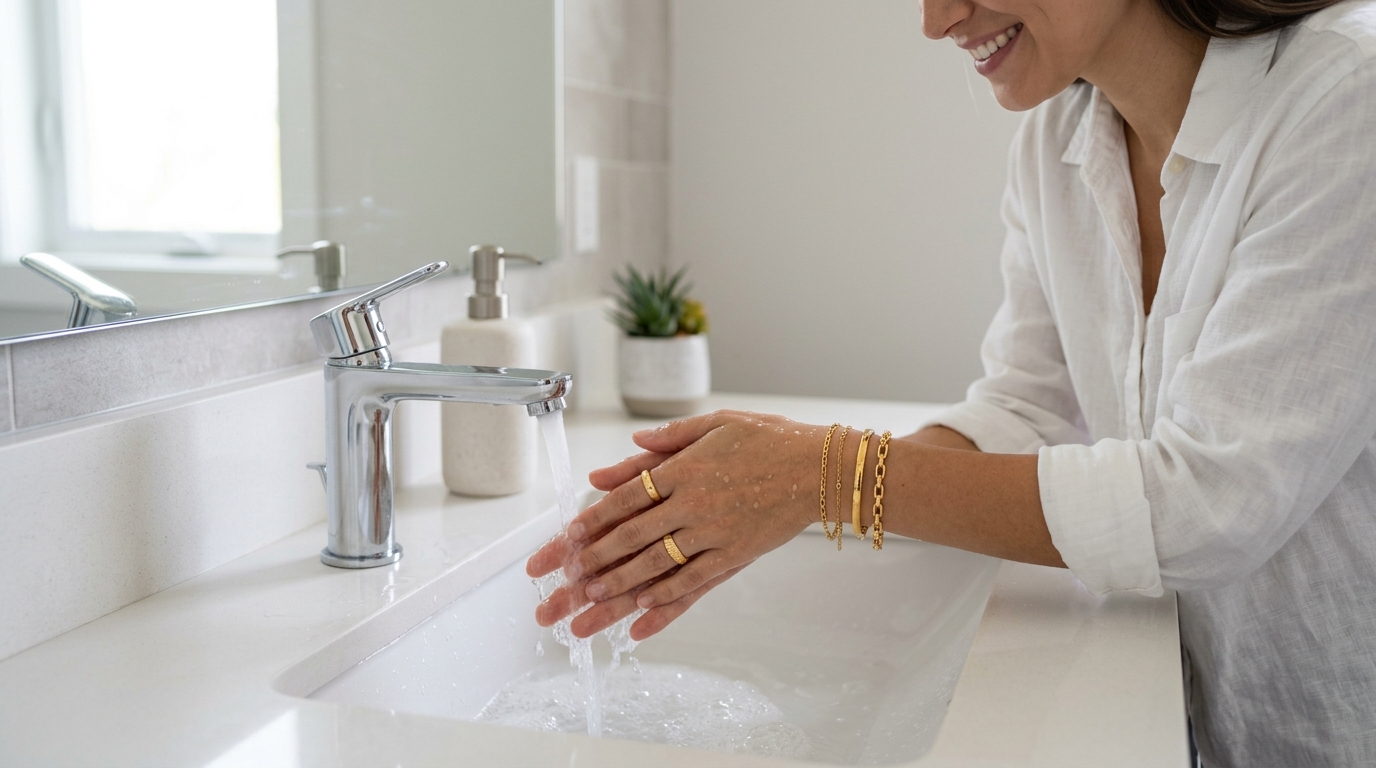
When I first started looking for ways to ensure my collections didn’t end up in the “tarnish pile” after a few months, I discovered Physical Vapor Deposition (PVD). This technology completely redefined what we consider tarnish-resistant jewelry. Instead of just coating a piece, we are fundamentally changing its surface.
In simple terms, PVD is a vacuum gold plating process. We place our 316L stainless steel pieces into a high-vacuum chamber. Using high temperatures and plasma, gold is vaporized and then “blasted” onto the jewelry. This isn’t a simple dip; it’s a high-tech transformation. As a specialized ODM/OEM jewelry manufacturer, I’ve seen how this shift from liquid baths to vacuum chambers has set a new standard for affordable luxury.
The real magic of 18k gold PVD coating is the molecular bonding process. Traditional electroplating just sits on top of the base metal like a thin coat of paint—it’s prone to chipping and flaking.
I always tell my customers to look at the numbers. While traditional plating might look okay on day one, it can’t compete with the lifespan of PVD.
| Feature | Traditional Electroplating | PVD Plating (Vacuum Gold) |
|---|---|---|
| Process | Chemical liquid bath | High-heat vacuum chamber |
| Bonding | Surface level adhesion | Molecular level fusion |
| Wear Resistance | Low (wears in months) | Extremely high (years of wear) |
| Eco-Impact | High (toxic chemical waste) | Clean (no hazardous runoff) |
| Salt/Sweat Proof | No | Yes |
Beyond the durability, PVD is simply better for the planet. Traditional gold electroplating involves cyanide-based solutions and toxic chemical baths that create hazardous waste. Physical Vapor Deposition is a dry process. There are no nasty liquids or fumes released into the environment, making it the preferred choice for modern, conscious brands. We apply this rigorous standard to our entire product catalog to ensure that “waterproof” isn’t just a marketing buzzword, but a manufacturing reality.
PVD plating is a powerhouse, but it needs a rock-solid foundation to work its magic. We use 316L surgical stainless steel because it is the only base metal that truly lives up to the “waterproof” claim. While other brands might cut corners with brass or copper, we stick to medical-grade steel to ensure your jewelry never reacts with your skin or the environment.
To understand why some “waterproof” jewelry fails, you have to look at the base. 316L steel is non-porous and incredibly dense. When we apply vacuum gold plating, the gold atoms don’t just sit on top; they bond to a surface that is already naturally resistant to rust and corrosion. This is why our pieces handle the “does waterproof jewelry tarnish” test so much better than traditional gold-dipped items.
| Feature | 316L Surgical Steel | Cheap Alloys (Brass/Zinc) |
|---|---|---|
| Corrosion Resistance | Extremely High | Low (Turns green/black) |
| Skin Reaction | Hypoallergenic | Often causes rashes/irritation |
| Durability | Won’t dent or bend easily | Soft and fragile |
| Water Exposure | Safe for salt and pool water | Rapidly degrades |
The primary reason we choose this specific grade of steel is its molybdenum content. This extra element makes the metal immune to “pitting” caused by chloride. Whether you are hitting a heavy workout or swimming in the ocean, the seawater-resistant properties of the steel ensure the structure remains intact. When comparing titanium vs. stainless steel jewelry, 316L is often the preferred choice for high-end PVD finishes because of its superior luster and weight.
If you’ve ever dealt with itchy skin or “green neck” syndrome, the base metal was likely the culprit. Our 316L foundation is hypoallergenic, making it the safest bet for those with nickel sensitivities.
I get asked all the time if waterproof jewelry that won’t tarnish actually exists or if it’s just a marketing buzzword. To give you the truth, we have to look at how these pieces handle the daily grind. PVD plating isn’t just a coating; it’s a functional shield designed for the active lifestyle of the modern American consumer.
Sweat is acidic and loaded with sodium chloride. On traditional jewelry, this creates a chemical reaction that eats away at the finish. Because PVD is bonded at a molecular level, your sweat-proof accessories won’t flake or peel after a heavy lifting session or a long run. The salt simply sits on the surface rather than corroding the metal beneath.
You don’t want to take your jewelry off every time you hop in the shower. Most body washes and shampoos are pH-balanced and won’t harm a PVD finish. However, I always recommend avoiding “exfoliating” scrubs directly on the jewelry, as the physical grit can act like sandpaper over several years. For daily wear, no tarnish waterproof jewelry handles tap water and standard soap without losing its luster.
Saltwater and pool chemicals are the “final bosses” of jewelry durability. While 18k gold PVD coating is incredibly tough, the base metal matters most here. Using high-grade steel is essential; you can see why in this 304 vs 316L stainless steel jewelry guide for brands, which explains how the right alloy prevents pitting in seawater.
Is PVD jewelry “forever” like a $2,000 solid gold ring? No. But it is the gold standard for jewelry longevity in the affordable luxury space.
| Exposure Type | Traditional Plating | PVD Plated Jewelry |
|---|---|---|
| Daily Showers | Fades in 1-3 months | Lasts 2+ years |
| Gym/Sweat | Turns green/black quickly | Maintains gold finish |
| Ocean/Pool | Immediate damage | Highly resistant |
When we talk about does waterproof jewelry tarnish, we are looking at a 2-to-5-year window of “like-new” performance. For a fraction of the cost of solid gold, you’re getting a piece that survives the beach, the gym, and the shower without a second thought.
PVD plating has completely disrupted the market by offering the high-end look of solid gold at a fraction of the cost. I’ve watched the industry move away from cheap brass and copper because customers are tired of “disposable” accessories. By applying vacuum gold plating to a durable base, we provide an affordable luxury experience. This process ensures that the question of does waterproof jewelry tarnish is no longer a concern—you get the 18k gold glow without the heavy price tag of solid gold.
For any growing brand, scaling relies on one thing: customer trust. Startups are ditching traditional electroplating because it fails too quickly, leading to returns and bad reviews. We focus on 316L surgical stainless steel because it’s the only foundation that truly supports a long-lasting PVD bond. This combination allows us to scale high-quality collections, including specialized items like custom nose studs, while maintaining a reputation for tarnish-resistant jewelry that survives real-world wear.
The shift to Physical Vapor Deposition isn’t just a trend; it’s a total overhaul of jewelry manufacturing standards. Modern collections are now built for high-durability, moving toward a more sustainable and reliable production model that prioritizes the user’s lifestyle.
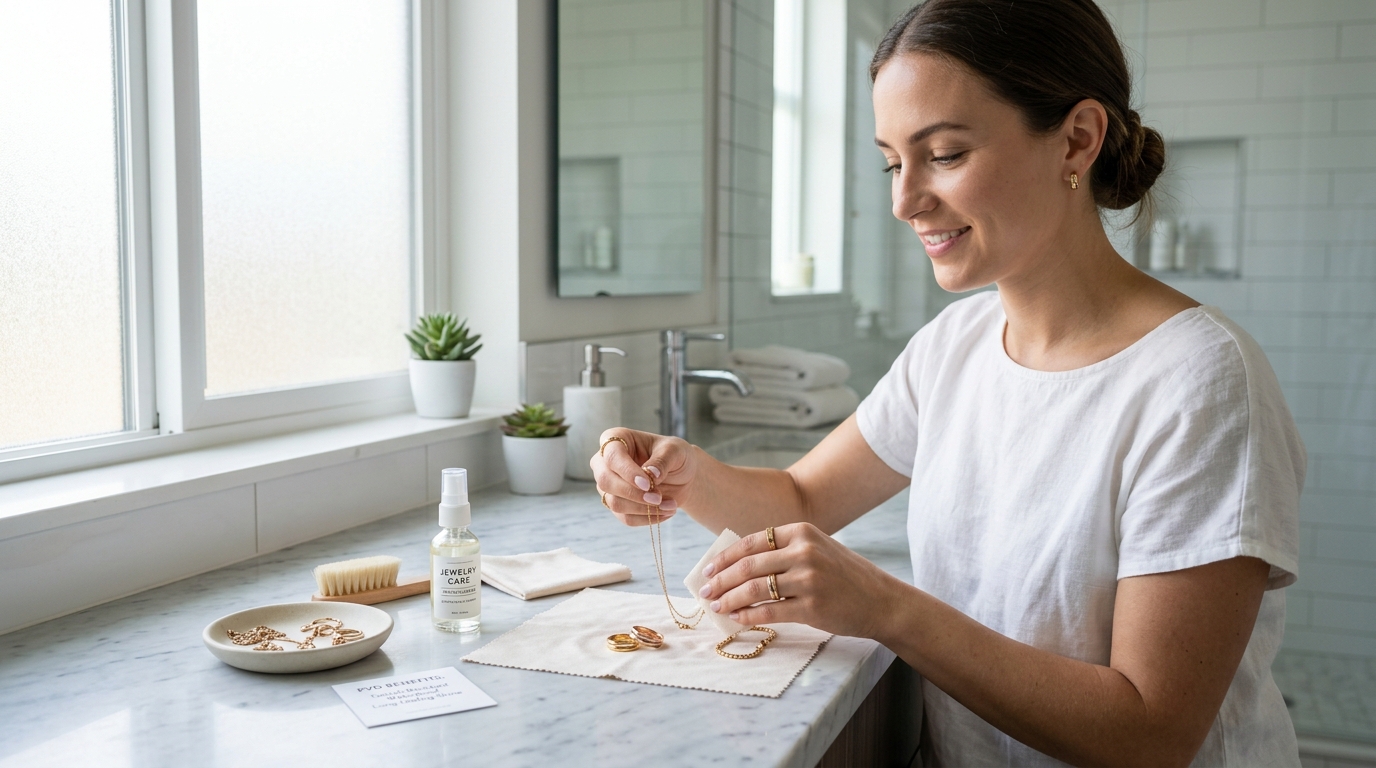
Even though PVD-coated pieces are built for the grind, a little common sense goes a long way in preserving that 18k gold shine. Here is how I recommend maintaining your collection to ensure your waterproof jewelry looks brand new for years.
Most people reach for a silver polishing cloth the moment they see a smudge. Stop right there. Those cloths are often infused with harsh abrasives meant to strip oxidation off silver. Since PVD is a molecular bond, those chemicals can actually micro-scratch the gold finish over time. You don’t need to “polish” PVD; you just need to clean it.
Forget the ultrasonic cleaners or jewelry dips. If your tarnish-resistant jewelry loses its luster due to sweat or sunscreen buildup, follow this simple routine:
This gentle approach works wonders for everything from heavy chains to delicate custom stainless steel earrings, ensuring the gold layer remains vibrant without chemical interference.
PVD is incredibly hard, but it isn’t invincible against diamonds or sapphires. To avoid scratches, store your pieces in individual soft pouches. If you are sourcing from a stainless steel necklace jewelry manufacturer, you’ll notice the base metal is incredibly tough, but keeping your gold-coated items separate from harder gemstones prevents unnecessary friction.
Yes, you absolutely can. Unlike traditional gold-filled or plated pieces that peel when exposed to salt, PVD gold plating is vacuum-sealed to the base metal. It handles seawater remarkably well. While I always suggest a quick rinse with fresh water after a beach day to remove salt residue, the finish itself is built to withstand the elements without corroding.
No. That annoying green tint is the result of copper oxidation found in cheap alloys. Because we use 316L surgical stainless steel as our core, there is zero copper to react with your skin or sweat. Our high-grade stainless steel jewelry won’t turn your skin green, ensuring a clean look no matter how much you wear it.
When it comes to jewelry longevity, PVD is the heavyweight champion. Under normal daily wear—including showers and workouts—you can expect the finish to stay vibrant for 2 to 3 years. This is a massive upgrade over standard electroplating, which typically begins to fade or flake within just a few months.
Yes, it is the industry standard for safety. By using hypoallergenic metals like surgical-grade steel and a clean vacuum deposition process, we eliminate the irritants that cause breakouts. If you have sensitive skin, PVD-coated stainless steel is the most reliable way to wear gold tones without the risk of an allergic reaction.
| Feature | Standard Electroplating | PVD Waterproof Jewelry |
|---|---|---|
| Does it tarnish? | Yes, quickly | No, tarnish-resistant |
| Ocean Safe? | No | Yes |
| Skin Reaction? | Common (Green/Itchy) | Hypoallergenic |
| Longevity | 3-6 Months | 2-3 Years |



Waterproof jewellery has become increasingly popular, and this article does a great job of explaining how PVD plating improves durability and resistance to tarnishing. The information is clear, practical, and helps readers understand what to look for when choosing long-lasting jewellery. The simple explanations make the topic easy to follow for both first-time buyers and jewellery enthusiasts. Thanks for sharing such a useful and informative guide.