Whatspp/Phone:
+8618666402929
Email:info@shinysteeljewelry.com
Factory address:
No. 5 Changsheng Road, Chang’an Town, Dongguan City, Guangdong Province, China.
 Skip to content
Whatspp/Phone:
+8618666402929
Email:info@shinysteeljewelry.com
Factory address:
No. 5 Changsheng Road, Chang’an Town, Dongguan City, Guangdong Province, China.

Struggling to decide if 316L Stainless Steel or 925 Sterling Silver is the right foundation for your next collection?
It’s the most specific, high-stakes debate in the modern jewelry industry.
Choose silver, and you gain tradition but risk tarnishing and high return rates.
Choose steel, and you tap into the booming waterproof jewelry trend, but worry about perceived value.
As a jewelry manufacturer with over a decade of experience, I’ve seen firsthand which metal actually builds scalable, profitable brands.
We aren’t just comparing aesthetics here. We are analyzing durability, profit margins, and hypoallergenic properties.
In this guide, you’ll get the technical breakdown you need to choose the material that maximizes your ROI.
Let’s get to work.
When you are sourcing products for your brand, the debate over is stainless steel or silver better for jewelry usually comes down to two main factors: longevity and market positioning. As a manufacturer working directly with overseas buyers, I see brands wrestling with this choice daily. To make the right call for your inventory, you need to understand exactly what you are buying.
Sterling silver is the traditional standard for “demi-fine” jewelry. It is an alloy consisting of 92.5% pure silver and 7.5% other metals, usually copper, to give it structure. While it has high perceived value in the consumer market, it is inherently soft and susceptible to oxidation (tarnish) over time. For brands, this often means higher maintenance costs and more delicate handling during shipping and storage.
This is the powerhouse material behind the modern stainless steel jewelry boom. In our Dongguan factory, we specialize in 316L Stainless Steel (and 304) because it offers an industrial-grade solution to fashion jewelry challenges. Unlike standard steel, 316L is:
When deciding is stainless steel or silver better for jewelry collections, the answer often comes down to performance in the real world. For brands targeting the modern, active consumer, the material properties of 316L stainless steel offer distinct advantages over traditional sterling silver.
For everyday wear, 316L and 304 Stainless Steel are significantly harder than precious metals. Sterling silver is naturally soft, making it prone to scratching, bending, and denting under daily stress. In contrast, stainless steel is engineered for structural integrity. This hardness is crucial for items like a precision-sized stainless steel ring, which relies on CNC manufacturing to maintain its exact shape and fit without warping over time.
One of the biggest complaints with silver is oxidation—it turns black and requires constant polishing. Stainless steel solves this maintenance headache.
Safety compliance is a major priority for US and European markets. While some silver alloys can trigger reactions, our manufacturing strictly uses 316L surgical steel.
You do not have to sacrifice the “luxury look” for durability. Through high-quality polishing and plating, a custom stainless steel necklace achieves a mirror-like finish comparable to white gold or platinum. Because the metal is harder, it retains its high-shine polish longer than softer metals, which dull quickly from micro-abrasions.
| Feature | 316L Stainless Steel | Sterling Silver |
|---|---|---|
| Durability | Very High (Scratch/Dent Resistant) | Moderate (Soft, scratches easily) |
| Maintenance | Low (Does not tarnish) | High (Requires regular polishing) |
| Plating Life | Long-lasting (PVD/IP Technology) | Fades faster due to base oxidation |
| Skin Safety | Hypoallergenic (Nickel-Free options) | Generally safe, but alloys vary |
| Cost Efficiency | High (Lower raw material cost) | Lower (Fluctuating market price) |
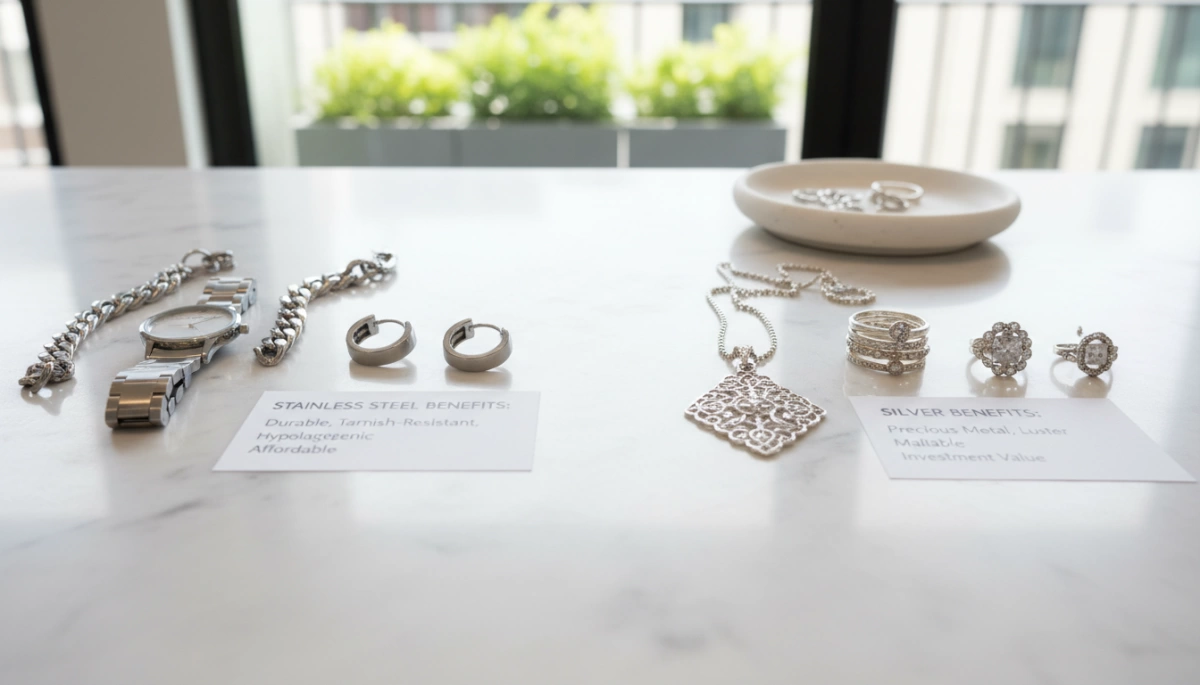
When brand owners ask whether stainless steel or silver is better for jewelry, the answer often comes down to the bottom line. While silver has a traditional history, 316L and 304 stainless steel offer a strategic advantage for modern jewelry businesses looking to maximize efficiency and minimize risk.
Sourcing directly from a factory significantly lowers your initial investment compared to precious metals. Because we operate as a direct manufacturer, we offer competitive, factory-direct pricing that removes middleman markups. This lower entry cost allows brands to apply advanced PVD and IP plating to achieve the look of gold or rose gold while maintaining healthy profit margins. You get a high-value aesthetic without the volatility of the silver or gold markets.
For a deeper dive into how this material impacts your bottom line, read about the benefits of choosing stainless steel jewelry for your business.
Returns are the silent killer of e-commerce profits. Stainless steel is engineered for durability; it resists scratching, does not tarnish like untreated silver, and is hypoallergenic. Our strict compliance with EU REACH and US Prop 65 standards means the jewelry is Nickel-Free and safe for sensitive skin. When customers receive a product that retains its color and doesn’t irritate their skin, return rates drop, and customer lifetime value increases.
Speed and flexibility are critical for US brands. Unlike traditional manufacturing that demands high volumes, we support scalability with a brand-friendly Minimum Order Quantity (MOQ) of just 50 pieces per style/size. This allows you to test new custom cast steel jewelry designs without committing to massive inventory. Combined with fast turnarounds—7-10 days for samples and 15-20 days for mass production—you can react to market trends instantly rather than waiting months for restocks.
While our factory specializes in high-performance custom stainless steel jewelry, we recognize that sterling silver holds a specific historical place in the market. If your brand is strictly targeting the traditional “fine jewelry” sector where the intrinsic market value of the raw metal is the primary selling point, silver is often the default choice despite its higher cost and maintenance needs.
The main reason designers might choose silver over steel is its malleability. Because 316L stainless steel is incredibly hard and durable, it requires specialized CNC machinery to shape. Silver is softer, which affects how it is handled during manufacturing and after purchase.
| Feature | Sterling Silver | 316L Stainless Steel |
|---|---|---|
| Market Tier | “Fine” or “Precious” Jewelry | Fashion, Bridge, & Daily Wear |
| Resizing | Can be resized by a jeweler | Not resizable (Permanent sizing) |
| Durability | Prone to scratching & bending | Industrial strength, scratch-resistant |
| Maintenance | Requires polishing (tarnishes) | Maintenance-free (PVD/IP Plating) |
The biggest functional limitation of stainless steel compared to silver is its inability to be resized. Since we manufacture rings using precision CNC technology for exact sizing, the final piece is permanent. Is stainless steel or silver better for rings that might need adjustment? If your business model relies on local jewelers resizing inventory, silver is the necessary option. Stainless steel is simply too hard for traditional resizing methods.
However, for brands focused on precise, consistent sizing from the start, our jewelry size guide ensures that mass production meets exact specifications without the need for post-production alterations.
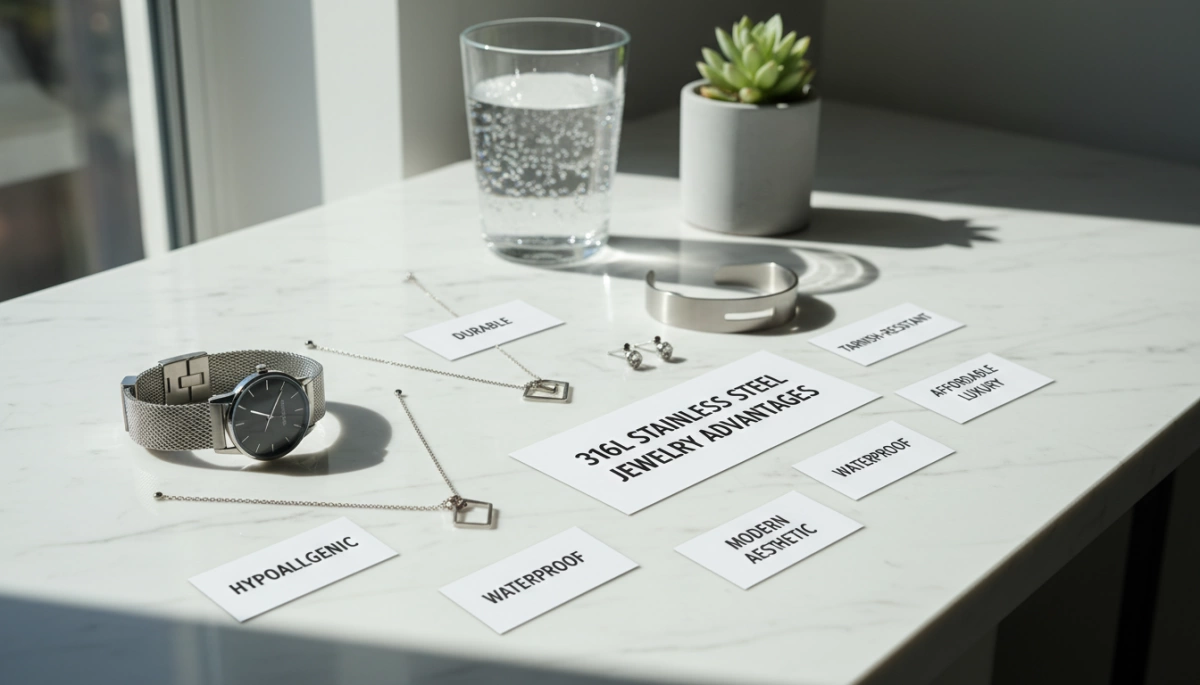
When looking at modern consumer habits, the debate over whether is stainless steel or silver better for jewelry has a clear winner. Today’s buyers want pieces they never have to take off, making steel the ultimate everyday metal for the US market.
The waterproof jewelry market is exploding right now. People want accessories that survive a sweaty gym session, a hot shower, and a weekend at the beach without a second thought. This is exactly where 316L surgical stainless steel dominates. It simply doesn’t oxidize, rust, or tarnish from daily moisture the way silver does. To see just how easy the upkeep really is, check out a solid ultimate care guide for stainless steel jewelry to realize it requires almost no effort.
If a customer asks me is stainless steel better than sterling silver, I immediately point to lifestyle suitability.
The biggest technological leap for the fashion sector is PVD gold plating durability. Traditional gold flash plating on silver fades and rubs off quickly, leaving dull patches behind. However, when PVD (Physical Vapor Deposition) is applied to a steel base, the gold coating bonds at the molecular level in a vacuum.
As an experienced stainless steel jewelry manufacturer, we see how this completely transforms the end product. You get the rich, vibrant look of solid gold that refuses to flake, giving your customers the true “wear anywhere” experience they expect.
No, high-quality 316L and 304 stainless steel will not turn your skin green. The “green finger” effect is typically caused by a chemical reaction between acids in the skin and metals like copper or brass. Since our stainless steel is stable, oxidation-resistant, and does not rely on cheap base metals, it remains safe for the wearer. This stability is a major reason why brands choose steel over lower-grade alloys.
While stainless steel is not classified as a “precious metal” like gold or platinum in terms of raw scrap value, its business value is immense. For a jewelry brand, the worth lies in customer satisfaction and product longevity. Stainless steel offers a premium look and heavy feel without the high price tag of precious metals, allowing for healthy profit margins while delivering a product that lasts for years.
Yes, stainless steel is highly resistant to water and corrosion, making it perfect for everyday wear. Unlike silver, which can tarnish quickly when exposed to moisture and humidity, stainless steel holds up exceptionally well. Our products utilize advanced PVD and IP plating technology (including gold and rose gold finishes) that bonds the color to the metal, ensuring it withstands showers, sweat, and swimming much better than standard plating methods.
For many consumers, the answer is yes. When considering whether stainless steel is better than sterling silver for earrings, durability and skin sensitivity are the deciding factors. 316L surgical steel is hypoallergenic, Nickel-Free, and compliant with EU REACH and US Prop 65 standards, making it ideal for fresh piercings and sensitive ears. Furthermore, steel is harder than silver, meaning posts won’t bend easily. This makes our custom stainless steel earrings a reliable choice for brands focused on safety and long-term wearability.


