Whatspp/Phone:
+8618666402929
Email:info@shinysteeljewelry.com
Factory address:
No. 5 Changsheng Road, Chang’an Town, Dongguan City, Guangdong Province, China.
 Skip to content
Whatspp/Phone:
+8618666402929
Email:info@shinysteeljewelry.com
Factory address:
No. 5 Changsheng Road, Chang’an Town, Dongguan City, Guangdong Province, China.

One of the biggest mistakes I see new entrepreneurs make when figuring out how to start a stainless steel jewelry business is trying to be the “Amazon of Jewelry.” If you try to sell everything to everyone, you end up selling nothing to anyone. In a crowded market, specificity is your superpower. General stores lack a clear identity, making it impossible to build brand loyalty or run targeted ads. To succeed, you must narrow your focus to a specific style or customer need.
Based on the thousands of OEM/ODM projects we handle, here are the high-growth categories that are currently dominating the market:
Before you order samples, you need to know exactly who will wear them. A detailed customer avatar helps you make decisions on pricing, design, and marketing channels.
Consider these factors for your ideal buyer:
Defining this early ensures you don’t waste capital on inventory that doesn’t fit your market.
When learning how to start a stainless steel jewelry business, knowing your metals is step one. You can’t build a reputable brand on cheap alloys that rust or cause skin breakouts. Here is the technical breakdown of what makes this material sell.
The industry relies heavily on two main grades of steel. While 304 is common, 316L is the superior choice for jewelry. It contains molybdenum, which drastically boosts its resistance to corrosion from sweat and saltwater. Whether I’m designing a heavy-duty men’s band or sourcing a delicate stainless steel necklace, I always prioritize 316L surgical steel wholesale suppliers to ensure top quality.
| Feature | 304 Stainless Steel | 316L Stainless Steel |
|---|---|---|
| Corrosion Resistance | Good | Excellent (Marine-grade) |
| Durability | High | Very High |
| Skin Sensitivity | Moderate | Highly Hypoallergenic |
| Best For | Budget accessories | Premium, everyday wear |
If you want to dominate the waterproof jewelry niche, you need to utilize PVD (Physical Vapor Deposition) plating. This process is exactly how brands make legitimate waterproof and tarnish-free claims.
To run a successful hypoallergenic jewelry business in the US market, compliance is mandatory, not optional.
When figuring out how to start a stainless steel jewelry business, your sourcing strategy is the foundation. Pick the right partner, and you scale. Pick the wrong one, and you drain your budget on unsellable stock.
You have three main paths to get your product:
Minimum Order Quantities (MOQs) are the biggest hurdle when starting a jewelry brand. Most factories want you to order thousands of units per style. You need a reliable low MOQ jewelry supplier that lets you test different styles without drowning in unsold inventory. Look for partners who understand the US market and are willing to scale production as your sales grow.
Understanding the difference between OEM and ODM is critical when talking to private label jewelry manufacturers.
Never wire money to a factory without thoroughly vetting them. Whether you are dealing with a local distributor or exploring custom jewelry manufacturing in China, use this checklist before signing any contracts:
Getting your ideas out of your head and into production is the most exciting part of how to start a stainless steel jewelry business. However, this phase requires clear communication and technical precision to avoid costly mistakes. You are building the blueprint for your brand’s physical product, so accuracy here is non-negotiable.
You do not need to be a professional artist to launch a line. We often work from simple hand sketches, mood boards, or even photos of existing items you want to modify. The key is clearly defining dimensions, materials, and finishes upfront. Our team specializes in a streamlined custom jewelry manufacturing process, guiding you from a rough concept to a production-ready specification sheet. We bridge the gap between your aesthetic vision and the engineering required to make it wearable.
Before we cut a single piece of steel, we digitize your design. CAD jewelry design services are essential because they allow us to visualize the piece from every angle before manufacturing begins. This step confirms that the design is actually manufacturable and comfortable to wear. It eliminates the guesswork, ensuring the final stainless steel ring or pendant looks exactly like your vision without wasting materials on failed attempts.
Never skip the sample phase. This is your physical proof of concept. Our facility typically delivers samples in 7-10 days, allowing for a quick review cycle. When your sample arrives, you need to audit it strictly to ensure it meets the standards of a premium brand:
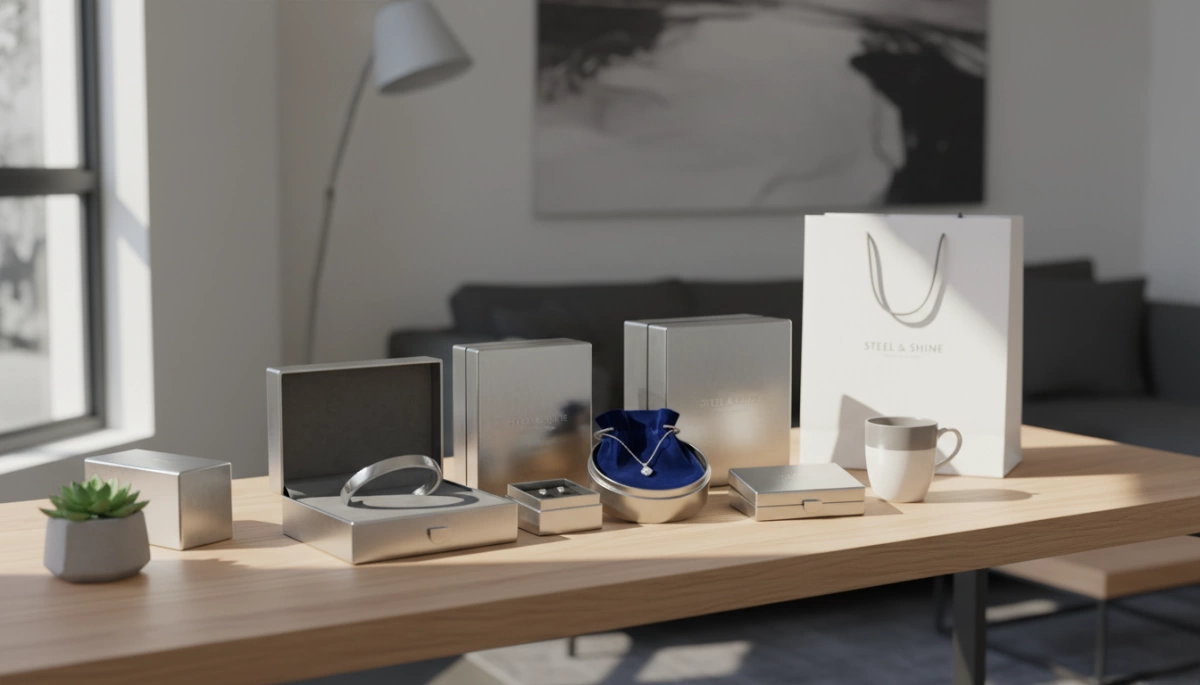
When you map out how to start a stainless steel jewelry business, you quickly realize that presentation dictates your price point. You might be selling affordable steel, but the perceived value needs to scream luxury. American buyers expect a premium unboxing experience, even for budget-friendly everyday wear. Strong jewelry packaging and branding instantly elevate your products from standard accessories to highly desired gifts.
To make affordable stainless steel jewelry feel like a high-end investment, focus on these physical touchpoints:
Adding a personalized touch is the easiest way to separate your brand from generic white label stainless steel jewelry. I always recommend applying your logo or a unique hallmark to the pieces themselves. Customization via laser engraving or metal stamping gives your line an exclusive, bespoke vibe. Adding personalized options like custom engraved stainless steel rings or stamped pendants allows you to command higher retail prices while keeping your base manufacturing costs low.
Never ship your products in flimsy plastic transit bags. The packaging is your first physical interaction with the customer, and you only get one chance to make a lasting impression.

If you want to know how to start a stainless steel jewelry business that actually lasts, you have to get comfortable with the numbers. Many creative founders ignore this part, but understanding your unit economics is the only way to scale. The beauty of stainless steel is that the base material is affordable, but the perceived value—especially with high-quality PVD gold plating—is incredibly high. This gap offers excellent potential for healthy margins if you calculate your costs correctly.
To set the right price, you need to know exactly how much it costs to deliver one piece of jewelry to a customer. It is not just about the manufacturing price. Your formula should look like this:
Stainless steel jewelry often competes visually with solid gold or vermeil but at a fraction of the production cost. This allows for a flexible pricing strategy. A common mistake is pricing too low, which hurts your brand image. Since our PVD plating is durable and waterproof, you can position your brand as “everyday luxury.”
A standard retail strategy is to aim for a 3x to 5x markup on your landed cost. For example, if a ring costs you $4 to manufacture and import, selling it for $12 leaves you with no room for marketing. Selling it for $25–$35 gives you the budget to grow while still offering great value to the customer.
One of the biggest barriers to entry is inventory risk. You shouldn’t have to order thousands of units just to test a new design. We support startups by offering a low MOQ of just 50 pieces per style. This allows you to launch a diverse collection—perhaps mixing rings, necklaces, and stainless steel body jewelry—without tying up all your capital in stock. By starting small, you can validate which designs sell best, keep your cash flow healthy, and reinvest profits into the winners.
When figuring out how to start a stainless steel jewelry business, your digital storefront is just as critical as the quality of your manufacturing. You need a platform that supports your brand identity, photography that proves the quality of the metal, and descriptions that reassure customers they are buying premium 316L steel, not cheap alloy.
Choosing the right sales channel depends on your business model. Are you building a long-term brand or looking for quick marketplace traffic? Here is a breakdown of the top contenders:
| Platform | Best For | Pros | Cons |
|---|---|---|---|
| Shopify | DTC Brands | Full control over branding, customer data ownership, and higher profit margins. | You must drive your own traffic through ads or social media. |
| Etsy | Niche/Handmade | Built-in audience looking for unique items; good for testing custom designs. | High transaction fees; hard to scale a mass-market stainless steel jewelry line. |
| Amazon | Volume Sellers | Massive traffic volume; FBA handles logistics. | Fierce price competition; strict rules; difficult to build brand loyalty. |
For most of our OEM/ODM partners, Shopify is the preferred choice because it lets you showcase the premium nature of your custom packaging and brand story without marketplace distractions.
In the waterproof jewelry niche, customers cannot touch the product, so your photos must do the selling. Standard photos won’t cut it; you need high-resolution macro photography to show the texture and finish.
Your product descriptions need to be more than just “Gold Necklace.” They must be technical and reassuring to convert skeptical buyers. Use LSI keywords naturally to capture search traffic and build trust.
Key elements to include in every description:
By combining sharp visuals with technical accuracy, you position your store as a professional authority rather than just another generic reseller.
Yes, absolutely. The stainless steel niche offers some of the best profit margins in the fashion industry. Because the raw material cost is significantly lower than silver or gold, your Cost of Goods Sold (COGS) remains low. However, the perceived value—driven by durability, weight, and “waterproof” marketing—allows you to command premium retail prices. When you partner with a direct stainless steel jewelry manufacturer, you cut out the middleman, maximizing the spread between your factory cost and your final retail price.
You don’t need a massive budget to get started, especially compared to fine jewelry. The biggest barrier to entry used to be high inventory requirements, but we have solved that for modern brands.
No. The “green skin” reaction is typically caused by the oxidation of copper found in cheaper alloys like brass or base metal. We strictly utilize 316L Surgical Stainless Steel and 304 Stainless Steel for our production. These materials are:
This is a critical distinction for quality. Traditional “gold plating” (often just a thin wash of color) fades quickly when exposed to water or sweat. In contrast, we use PVD (Physical Vapor Deposition) plating.


