Whatspp/Phone:
+8618666402929
Email:info@shinysteeljewelry.com
Factory address:
No. 5 Changsheng Road, Chang’an Town, Dongguan City, Guangdong Province, China.
 Skip to content
Whatspp/Phone:
+8618666402929
Email:info@shinysteeljewelry.com
Factory address:
No. 5 Changsheng Road, Chang’an Town, Dongguan City, Guangdong Province, China.

When building a jewelry brand, the “feel” and “survival” of your pieces in the real world determine your return rate and customer loyalty. I’ve seen firsthand how the physical characteristics of 316L surgical-grade stainless steel compare to solid gold (10k-24k), and the choice often comes down to how your customers live their lives.
Solid gold is a prestige material, but it is inherently soft. The higher the karat, the easier it scratches, dents, or loses its shape. In contrast, 316L stainless steel is an industrial-strength alloy designed to withstand extreme environments.
| Feature | 316L Stainless Steel | Solid Gold (14k-18k) |
|---|---|---|
| Hardness | Extremely High | Low to Medium |
| Daily Wear | Heavy-duty / Active | Gentle / Occasional |
| Shape Retention | Permanent | Prone to warping |
| Waterproof | Yes (100%) | Yes, but prone to dulling |
For a brand owner, “skin sensitivity” is a major liability. Surgical-grade steel is the industry standard for piercings and medical implants because it is biocompatible. While high-karat gold (18k+) is generally safe, lower-karat gold (10k or 14k) often contains nickel or copper alloys that trigger allergic reactions. By lead-testing and ensuring medical-grade steel, I provide a “safe-buy” guarantee for customers with sensitive skin.
Modern consumers—especially in the US market—demand wear-and-forget jewelry. They want to shower, gym, and sleep in their accessories without a complex cleaning routine.
Choosing 316L stainless steel allows my brand to promise a lifestyle of convenience without sacrificing the high-end aesthetic.
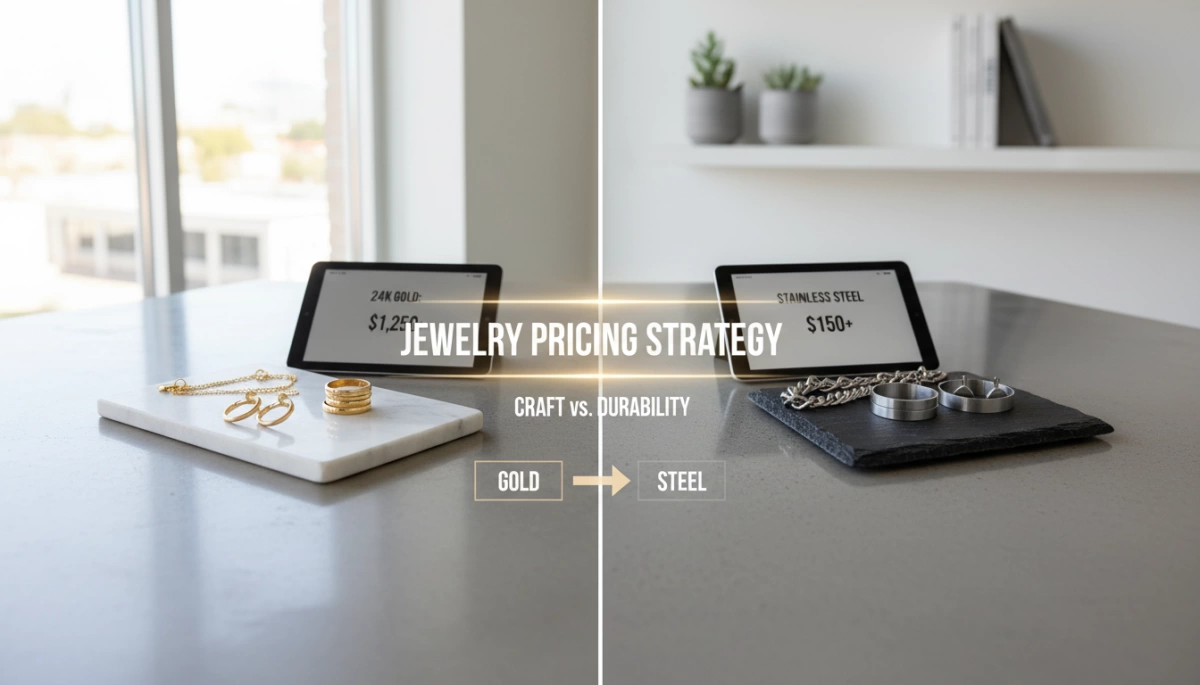
When evaluating stainless steel vs gold jewelry for your brand, the financial blueprint determines your ability to scale. Solid gold requires a massive upfront capital investment; stocking even a modest inventory of 14k or 18k pieces can tie up tens of thousands of dollars in “dead weight” on your shelves. In contrast, stainless steel allows you to launch a comprehensive collection with a fraction of the initial cost, freeing up your budget for marketing and brand development.
Launching a jewelry line involves significant risk, but the barrier to entry varies wildly between these two metals. For emerging brands, understanding how to import stainless steel jewelry from China is a game-changer. It allows you to maintain a deep inventory without the financial strain associated with precious metals.
Pricing strategy is where the two metals diverge. Solid gold targets the “Elite-Niche”—customers who view jewelry as an investment. However, this market is sensitive to economic downturns. Stainless steel thrives in the “Mass-Market” and “Bridge Jewelry” segments. Because the jewelry manufacturing costs for steel are stable, you can maintain consistent retail pricing regardless of fluctuations in the commodities market.
| Feature | Solid Gold (10k-24k) | 316L Stainless Steel |
|---|---|---|
| Initial Investment | Extremely High | Low to Moderate |
| Price Volatility | High (Market Dependent) | Very Low (Stable) |
| Profit Margin % | Moderate | High |
| Target Demographic | Luxury/Investment | Lifestyle/Trend-driven |
Managing the volatility of raw materials is a constant struggle with gold. One geopolitical event can send gold prices soaring, forcing you to either eat the cost or alienate customers with sudden price hikes. Steel provides a “safe harbor” for your business model, offering the stability needed to build a predictable, scalable e-commerce powerhouse.
When comparing stainless steel vs. solid gold jewelry, the visual gap has narrowed significantly due to modern finishing techniques. For a brand looking to scale, the ability to replicate a high-end look while maintaining industrial-grade durability is a massive competitive advantage.
The most effective way to bridge the gap between steel and gold is through 18k Gold PVD Plating. Unlike old-school electroplating, which wears off quickly, PVD (Physical Vapor Deposition) bonds the gold layer to the steel in a vacuum. This creates a finish that is exceptionally tarnish-resistant and mimics the exact luster of high-karat gold.
The manufacturing process for these two metals couldn’t be more different. Solid gold is often cast or handmade, which gives it a “soft” artisan feel but limits high-volume consistency. Stainless steel, however, is built for the modern era. As a private label jewelry manufacturer, I utilize CNC and laser-cutting technology to achieve sharp, geometric designs that are nearly impossible to replicate in soft gold.
In the US market, the “heft” of a piece often dictates its perceived value. Solid gold is dense and heavy, which traditionalists associate with luxury. Stainless steel is lighter, which has its own unique branding benefits for the affordable luxury branding sector.
| Feature | Stainless Steel (PVD) | Solid Gold (14k-18k) |
|---|---|---|
| Weight | Lightweight & “Active” | Heavy & “Substantial” |
| Surface Hardness | Very High (Scratch Resistant) | Low (Easily Scratched) |
| Design Style | Modern, Sharp, Industrial | Classic, Soft, Organic |
For products like stainless steel bangles, the lighter weight is actually a selling point for the “wear-and-forget” consumer. It allows for chunky, bold aesthetics that don’t feel cumbersome during a busy workday or a workout. We focus on maximizing this versatility to ensure your brand hits the sweet spot between luxury aesthetics and daily functionality.
The choice between stainless steel and solid gold often comes down to who you are selling to and what values your brand represents. Understanding these demographics is the key to a successful product launch.
Modern consumers, particularly Gen Z and Millennials, prioritize versatility and “wear-everywhere” durability. They lead active lifestyles—hitting the gym, traveling, and working—and they don’t want to worry about removing their jewelry. 316L surgical grade stainless steel has become the gold standard for this demographic because it is waterproof, sweat-proof, and tarnish-resistant. It allows brands to offer high-style custom fashion jewelry that fits the “affordable luxury” aesthetic without the high-maintenance requirements of precious metals.
While the mass market moves toward steel, the “Investment Collector” remains loyal to solid gold.
Environmental impact is a major factor in jewelry market trends 2026. Gold mining is an invasive process that often involves heavy chemical usage and significant land disruption. On the other hand, stainless steel is one of the most sustainable jewelry materials on the market.
Choosing the right material defines your brand’s footprint. If your identity is built on modern, eco-conscious, and high-durability products, stainless steel provides the strongest market positioning.
Choosing between stainless steel vs. solid gold jewelry is a foundational decision that dictates your price point, marketing voice, and customer retention strategy. Your choice should align with how you want the world to perceive your brand’s value and longevity.
If your brand identity centers on exclusivity and heirloom quality, solid gold is the standard. This path targets the “Elite-Niche” consumer who views jewelry as a financial investment.
For brands built on high-volume sales and social media trends, 316L stainless steel is the superior strategic choice. It allows for aggressive scaling without the massive capital tied up in gold inventory. Modern consumers prioritize “wear-and-forget” durability, making 316L surgical grade stainless steel the ideal material for active lifestyles.
I often recommend a hybrid approach for growing labels. By mixing metals, you can capture a wider market share:
This tiered strategy allows you to maintain a premium brand image while utilizing the high-volume production benefits of steel to fuel your cash flow. Whether you aim for the luxury of gold or the resilience of steel, your material choice must reflect the lifestyle of your target audience.
Scaling a jewelry brand requires a partner that balances high-end aesthetics with industrial-strength reliability. At ShinySteelJewelry, we provide the infrastructure and material expertise necessary to move from small batches to high-volume success without compromising the “luxury” feel your customers demand.
We built our reputation on 316L Surgical Grade Stainless Steel. This material is the backbone of the “affordable luxury” movement. It is inherently tarnish-resistant, corrosion-resistant, and 100% hypoallergenic. While solid gold is soft and prone to scratching, our surgical steel maintains its structural integrity even with daily wear. As a dedicated stainless steel jewelry manufacturer, we ensure every piece meets the strict quality standards required for the US and European markets.
The biggest challenge in the Stainless Steel vs. Solid Gold Jewelry debate is the visual finish. We solve this using Advanced 18k Gold PVD Plating. Unlike traditional electroplating which flakes off, PVD (Physical Vapor Deposition) bonds the gold layer to the steel at a molecular level.
We specialize in helping brands transition from boutique operations to e-commerce powerhouses. Our facility is optimized for precision and speed, utilizing CNC technology and laser cutting to achieve details that are often impossible or too expensive to do by hand in solid gold.
Whether you are developing a line of custom men’s accessories or a signature minimalist collection, our bulk manufacturing process offers:
By choosing ShinySteelJewelry, you aren’t just buying inventory; you are investing in a supply chain designed for high-volume, low-return sales and maximum brand loyalty.
When deciding between materials for your collection, these are the questions I hear most often from brand owners looking to scale.
Quick Comparison for Brand Strategy:
| Feature | 316L Stainless Steel | Solid Gold (14k-18k) |
|---|---|---|
| Durability | High (Scratch resistant) | Moderate (Soft metal) |
| Maintenance | Zero (Tarnish-resistant) | Periodic polishing required |
| Profit Margin | High (Low COGS) | Lower (High material cost) |
| Market Reach | Gen Z, Millennials, Active | Luxury collectors, Investors |

